





VIDA SEPLIF ®Tudo o que você precisa saber sobre cromatografia de troca iônica
Introdução à cromatografia de troca iônica:
A cromatografia de troca iônica é um método de cromatografia em coluna que utiliza a diferença na força eletrostática entre os íons trocáveis no trocador iônico e os diversos íons separados no meio circundante, alcançando o objetivo de separação por meio do equilíbrio de troca. A cromatografia de troca iônica apresenta vantagens como alta sensibilidade, repetibilidade, boa seletividade e rapidez na análise, sendo atualmente um dos métodos cromatográficos mais utilizados.
Em 1848, Thompson et al. descobriram o fenômeno da troca iônica durante o estudo da troca de substâncias alcalinas no solo. Na década de 1940, surgiram as resinas de troca iônica de poliestireno com características de troca estáveis. Na década de 1950, a cromatografia de troca iônica entrou no campo da bioquímica e foi aplicada à análise de aminoácidos. Atualmente, a cromatografia de troca iônica ainda é um método cromatográfico comumente utilizado na área da bioquímica, sendo amplamente empregada na separação e purificação de diversas substâncias bioquímicas, como aminoácidos, proteínas, açúcares, vírus e nucleotídeos.
O processo de troca iônica:
A reação entre o trocador iônico e os íons ou compostos iônicos na solução ocorre principalmente por troca iônica. A reação de troca iônica realizada é reversível. Considerando que RA representa o trocador catiônico, o cátion A+ dissociado na solução pode sofrer uma reação de troca reversível com o cátion B+ na solução, e a fórmula da reação é:
RA + B+ → RB + A+
A reação atinge o equilíbrio a uma velocidade extremamente rápida, e o deslocamento do equilíbrio segue a lei da ação das massas.
A seletividade de um trocador iônico pode ser expressa pela constante de equilíbrio K de sua reação:
K = [RB][A+]/[RA][B+]
✔Se [A+] for igual a [B+] na solução de reação, então K=[RB]/[RA].
✔Se K>1, ou seja, [RB]>[RA], significa que a força de ligação do trocador de íons ao B+ é maior do que a do A+;
✔Se K=1, ou seja, [RB]=[RA], significa que o trocador de íons tem a mesma força de ligação para A+ e B+;
✔Se K
✔O valor K é um parâmetro que reflete a força de ligação ou seletividade do trocador iônico para diferentes íons, sendo assim denominado coeficiente de seletividade do trocador iônico para A+ e B+.
Mecanismo de troca iônica:
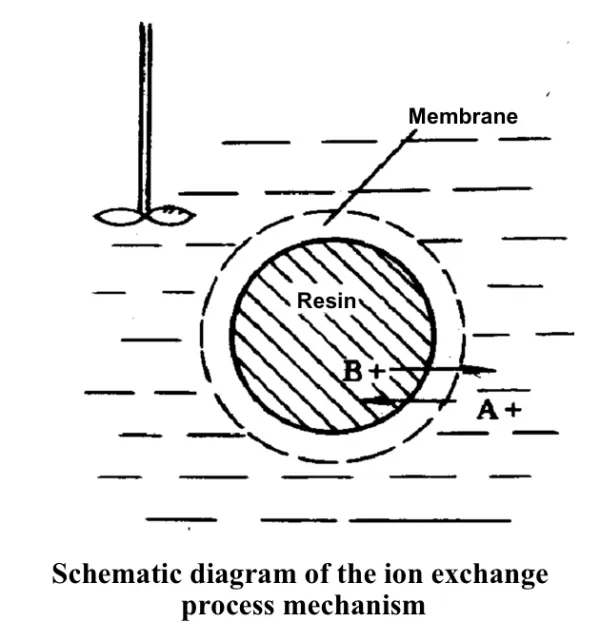
O íon A+ difunde-se da solução para a superfície da resina.
O íon A+ entra no centro ativo dentro da resina a partir da superfície da resina.
A+ sofre reação de metátese com RB no centro ativo.
O íon B+ dessorvido difunde-se do interior da resina para a superfície da resina.
Os íons B+ se difundem da superfície da resina para a solução.
The controlling step of the exchange rate is the rate of diffusion, which may be controlled by internal diffusion or external diffusion in different separation systems.
Factors Affecting the Ion Exchange Process:
✔Particle size: the smaller, the faster
✔Degree of cross-linking: small degree of cross-linking, fast exchange speed
✔Temperature: the higher the faster, it is related to the increase of the diffusion coefficient
✔Ion valence: the higher the valence, the slower the diffusion rate
✔Ion size: the smaller the faster
✔ Stirring speed: to a certain extent, the bigger the faster
✔Solution concentration: When the exchange rate is controlled by diffusion, the greater the concentration, the faster the exchange rate
Principle of ion exchange:
If a cation exchange resin is selected, the positively charged substance is exchanged with H+ and bound to the resin. If an anion exchange resin is selected, the negatively charged substance can be exchanged with OH- and bound to the resin.
There are differences in the degree of firmness of the combination of substances on the resin, and the components in the mixture can be eluted one by one by selecting an appropriate eluent to achieve the purpose of separation and purification.
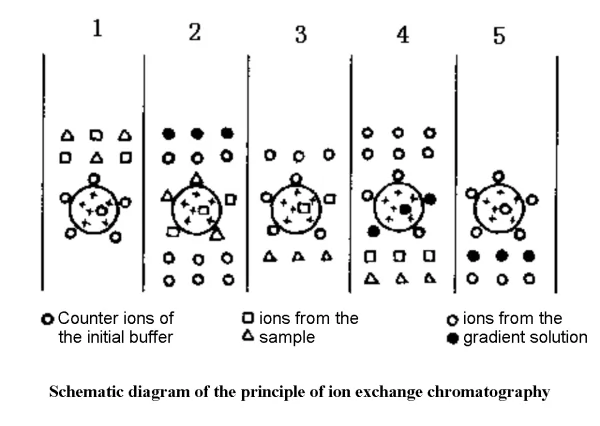
✔1. Equilibration stage: combination of ion exchanger and counter ion
✔2. Adsorption stage: sample and counter ion exchange
✔3. Desorption stage: the gradient buffer solution first washes off the weakly adsorbed substances, and then washes off the strongly adsorbed substances
✔4. Regeneration stage: fully wash with the original balance solution, which can be reused
Ion exchange chromatography resins:
The charged groups of cation exchangers are negatively charged, and the counter ions are positively charged, which can perform exchange reactions with cations or positively charged compounds in solution.
According to the strength of the charged group, it can be divided into three types, respectively strong acid type (group with sulfonic acid, R-SO3H), medium-strong acid type (containing phosphoric acid group or phosphorous acid group, R-PO3H2) and weak acid type (with carboxyl group and phenol-based resin, R-COOH or R-benzene ring-OH).
During the exchange of these exchangers, the hydrogen ions are replaced by foreign cations, as shown in the following formula:
R-COOH+Na+=R-COONa++H+
The anion exchanger is formed by introducing quaternary amine [-N (CH3) 3], tertiary amine [-N (CH3) 2], secondary amine [-NHCH3] and primary amine [-NH2] groups on the matrix.
According to the different level of alkalinity of the amine groups, it can be divided into three types, respectively strongly basic (including quaternary amino group), weakly basic (including tertiary and secondary amino group) and mediumly basic (containing both strong basic group and weak basic group).
When they exchange with ions in solution, the reaction formula is the following:

Para obter mais informações sobre os tipos específicos de resinas de cromatografia de troca iônica, fique atento ao nosso próximo artigo sobre Cromatografia de Troca Iônica.
Contate-nos


